What If We’ve Been Teaching Backwards All Along?
After nearly 30 years in education — in classrooms filled with students of every ability level, background, learning style, and starting point — I began
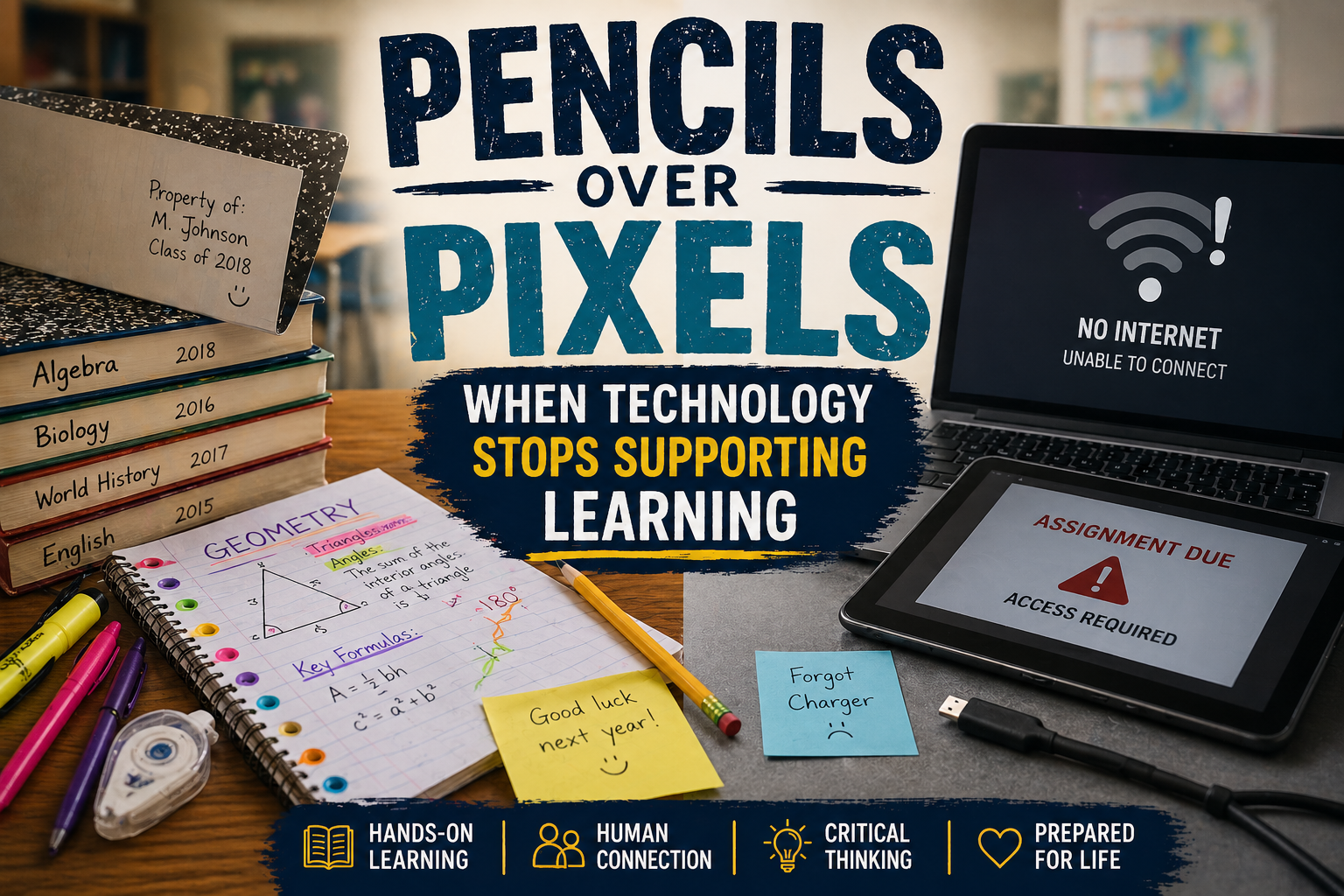
A growing movement is gaining traction in school districts across the country: Pencils Over Pixels. At its core, it is not anti-technology. It is pro-balance. It asks a simple but powerful question: Have we gone too far?
As a special educator, I was immediately intrigued when I first heard about it. Most of my school day is spent teaching students through hands-on, face-to-face instruction. Aside from the 25-30 minutes daily that I am mandated to spend using an online program with my students, my classroom runs largely without screens. And truthfully, that required block of technology has had little to no positive influence on their growth.
That is what many parents and teachers are beginning to realize: technology itself is not the issue. The problem is the all-or-nothing mindset education adopted.
Technology was supposed to enhance learning. Instead, it became the center of it.
Textbooks disappeared and became digital licenses. Paper assignments became links. Notes became Google Docs. Reading became scrolling. If a student forgets their Chromebook, has no charger, or the device dies during the day, learning often comes to a halt. That is not innovation. That is dependency.
In my own household, I recently had to replace a tiny Chromebook stylus for the second time in just a few years. Cost: $53. Not covered by the insurance families like myself already pay. It is hard to imagine any educator or parent designing a system that relies on expensive, easy-to-lose accessories for middle school students. Clearly not a well thought-out plan, or maybe a really great deal on a really crappy product that they threw into our children’s hands to check a box? If I had to guess, I’d say a little bit of both.
And the hardware is only the beginning.
What happens when the internet goes down? I know exactly what happens because I have lived it, not just for a period, not for a day, at times upwards of two weeks. Instruction stops. Teachers scramble in real time to redesign lessons built from online platforms with no consumable resources to draw from, while students sit waiting. Suddenly we are expected to pivot back to pencil-and-paper instruction in buildings with limited printer access, little ink, scarce copy paper, pacing guides still looming, and evaluation systems still in place.
Yet somehow, we continue pretending this model is more efficient.
Another reality many parents are completely unaware of is that in some districts, technology use must actually be scaled back or paused during weeks of standardized testing because there simply is not enough bandwidth to support both online testing and regular classroom instruction at the same time. Let that sink in. In school systems that have gone all-in on digital learning, students may be asked to limit device use, avoid certain platforms, or shift instruction entirely so the network can prioritize testing and avoid glitches. If the infrastructure cannot support both learning and testing simultaneously, then what exactly are we calling progress?
Parents deserve to know that in some schools, the educational day must bend around the demands of technology rather than the technology supporting the educational day.
The rise of AI and educational technology was supposed to make teaching better. In some ways, it has. But in many others, it has made schools lazy. I do not say that lightly.
I recently asked my 14-year-old daughters what they thought about the Pencils Over Pixels movement. Their response surprised me, especially from two teens who love their phones!
They agreed there is too much technology in school.
Then one said something even more striking:
“Technology has made teachers lazy. My forensic science class consists of us watching a video and answering questions about it! How is that fun OR interesting? I love my science class on lab days because we actually get to use our hands!”
As both a parent and veteran educator, I could not disagree, and I could not dismiss it.
Too often, lessons are now built around assigning a video, posting slides, or pushing students through software programs that promise personalization while removing the most important element of education: human connection.
What started as a necessary lifeline during the pandemic quietly became a crutch after schools reopened.
We never fully returned.
And students are paying the price.
We talk constantly about equity, yet we replaced hard-copy textbooks with online resources regardless of whether students had reliable internet, working devices, tech support at home, or parents who understood the platforms. We introduced systems that move at digital speed for children who need accommodations, repetition, slower pacing, sensory breaks, or direct support.
For many students, especially those receiving special education services, this has not been progress. It has been displacement.
Hands-on interventions became screen-based subscriptions. Individualized support became algorithmic pathways. Relationships became logins.
Then there is the cost.
Districts facing serious budget concerns continue pouring money into hardware, software, subscriptions, monitoring tools, testing platforms, and replacement parts. Devices break. Smartboards fail. Printers sit unused because ink costs more than the machines themselves. Meanwhile, programs like i-Ready, IXL, Freckle, Khan Academy, and GoGuardian consume enormous budgets year after year.
At some point, we need to ask whether we are funding learning or funding systems.
This is why Pencils Over Pixels matters.
Not because pencils are magical.
Not because screens are evil.
But because education works best when tools serve instruction, not when instruction serves tools.
Students still need to annotate books. Write notes by hand. Solve problems on paper. Highlight vocabulary. Feel pages turn. Build stamina. Talk face-to-face. Struggle productively. Create physically. Think deeply without a tab open beside them.
I still remember sitting in high school geometry class and quietly marveling at my friend sitting next to me whose notes looked like works of art. Every page was carefully organized, color-coded, highlighted, and perfectly maintained. White-out was always nearby. Those little circle reinforcer stickers were placed over binder holes so pages would never rip out. There was pride in it. Ownership. A system. You learned not just geometry, but how to organize information, care for materials, and build habits that lasted far beyond the classroom.
I also remember the oddly exciting moment at the start of every school year when teachers handed out textbooks and the first thing you did was flip open the cover to see who had owned it before you. Names written in fading ink from years past. Maybe an older sibling, maybe someone you knew, maybe someone who had graduated long ago. It made the book feel like it had a story before it ever reached your desk. And of course, there was always the chance of discovering answers tucked somewhere in the margins or lightly written in code by previous tenants of the book, as if they were leaving behind clues for the next generation. Even something as simple as that created connection, curiosity, and a sense that school was part of something bigger than just your own schedule.
Technology absolutely has a place in schools. But it should be a tool in the toolbox, not the toolbox itself. A hammer is just a hammer until it is placed in someone’s hand and used with purpose, skill, and intention. The same is true of technology. It is not the learning. It is only one tool that can help build it when used wisely.
Before we hand another generation a device and call it progress, maybe we should ask a better question: What kind of learners are we creating?
Are we building thinkers, communicators, resilient young people, and problem-solvers? Or are we building students who can click, swipe, submit, and move on?
Parents, educators, and students all experience this differently, and every perspective matters. Has technology improved learning in your home or classroom? Where has it helped? Where has it clearly gone too far?
The conversation matters now more than ever.
It is time to level the pencil-to-pixel ratio before we lose another generation to convenience disguised as progress.
After nearly 30 years in education — in classrooms filled with students of every ability level, background, learning style, and starting point — I began